CRM, automation and lead management
CRM systems designed around how your team actually works, with the automations, lead routing and database infrastructure built around them: HubSpot, GoHighLevel, Salesforce, Pipedrive, Close, Zapier, Make and n8n.
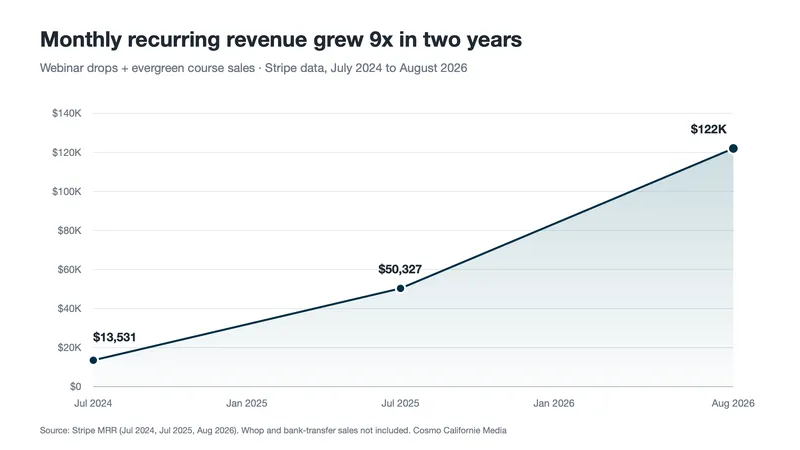
Cosmo Californie Media designs and deploys CRM systems that match how a team actually works, then builds the automations, lead routing and database infrastructure around them. The work covers HubSpot, GoHighLevel, Salesforce, Pipedrive and Close, with Zapier, Make and n8n connecting the rest of the stack, and it ranges from a first CRM for a business running on spreadsheets to owning the whole back end of a launch-driven company. A sales system we built for an agency returned 37.03x on a $10,900 investment, and two years of automation infrastructure for an online education business saw its monthly recurring revenue grow 9x.
- Who it is for
- Businesses whose leads come in but whose follow-up, hand-offs and data entry depend on people remembering
- What is included
- Stack audit, CRM design and migration, lead routing, automated follow-up, error logging, documentation and training
- Platforms
- HubSpot, GoHighLevel, Salesforce, Pipedrive, Close; Zapier, Make, n8n; Supabase and Postgres for custom data layers
- Typical timeline
- Audit and design in the first month; a first CRM live in 4 to 8 weeks; larger stacks run as an ongoing retainer
- Billing
- Fixed-fee project from the audit, or a monthly retainer; change orders at $60 an hour
What does the service include?
We start with an audit of the stack you already have: where leads land, who touches them, which tools hold which records, where data is entered twice and where it silently stops. From the audit we design the CRM around the way the team sells, pick the platform that fits that stage, migrate the history without breaking live workflows, and build the automation around it: lead routing, follow-up sequences, round-robin assignment, notifications to the right people, and the sync between the CRM, the ad platforms, the calendar, payments and email. Every system is documented in plain language and the team is trained on it, so it keeps working after we step back.
Why is this where growth gets stuck?
Growth is rarely limited by marketing performance alone. It is most often constrained by disconnected systems behind the scenes. Demand exists, but the handoff between marketing and sales is loose, follow-up varies by channel, the CRM is underused or set up for a different business, and the person who built the automations has left. Many of our clients in 2025 engaged us for this work alone, with no advertising attached, because their issue was what happened after a lead entered their ecosystem.
What have you built?
- A sales system for a marketing agency with three years of flat revenue and no CRM: Close CRM with a power dialer, a semi-automated audit of each prospect, outbound by email and automated direct mail, and an interactive nurture campaign. The agency invested about $11,000 over six months, broke even in month three and reached $67,250 in monthly recurring revenue, a 37.03x return, with 87% of clients in the nurture upgrading their services.
- Two years as the back end of an online education business: nearly 30 connected tools, payments from Stripe, Whop and bank transfers translated into course access, a CRM moved from Google Sheets to Close once events hit 15,000 leads, round-robin routing across 3 setters and 5 closers, and live support during every cart opening. Monthly recurring revenue grew from $13,530.56 to $122K. All of it was built without AI.
- Zapier and Make scenario maintenance for a coaching brand and a marketing agency with 30+ clients: audited scenarios, consistent naming and step order, and an error log with real-time alerts. The agency cut its automation build time during onboarding by 61%, and the coaching brand now has ads live within two days of a new course.
- A lead tracking system in Google Sheets for a service business whose lead system and CRM did not talk, with 99% attribution across the customer lifetime.
Which platform should a business use?
The one the team will actually use. A first CRM has to be simple to adopt, which is why the agency above went on Close rather than Salesforce, and why a service business got a Google Sheet with the automation underneath it. A launch-driven business with a sales team needs pipelines, smart views by role and live lead scoring. GoHighLevel suits service businesses that want the CRM, calendar, email and SMS in one place. HubSpot fits B2B teams with a longer sales cycle. Where off-the-shelf tools cannot reach, we build the layer ourselves on Supabase and Postgres, with n8n for self-hosted workflows and direct API and webhook integrations.
Where does AI fit?
We bring AI into client systems where it adds real value, such as lead classification, data enrichment and parsing unstructured inputs, and we keep rule-based work in n8n, Make or Zapier, where every run is logged step by step and anyone on the team can see what happened and why. That record is often harder to get from an AI routine, so choosing the right tool for each job is part of the design. The best automation engineers understand the foundation the AI sits on.
What does it cost?
A first CRM or a defined automation build is usually a fixed-fee project scoped from the audit, with the audit fee credited against it. Ongoing ownership of a stack, including monitoring, error logs, new builds and vendor management, runs as a monthly retainer. Consulting and change orders are $60 an hour, agreed before the work starts. Platform subscriptions are billed to you directly, and the credentials, accounts and documentation stay yours.
If your business depends on a stack nobody fully owns, shoot me a message and we can map out what it is already capable of and where to take it next.
Book a CallQuestions about this service
Which CRMs do you implement?
HubSpot, GoHighLevel, Salesforce, Pipedrive and Close, chosen by the stage of the business and the way its team sells. Sonny was a Salesforce power user before founding the agency, and the team has migrated businesses from spreadsheets, from one CRM to another, and from a CRM that was set up for a different business model.
Which automation tools do you use?
Zapier and Make for most workflows, n8n where a business wants self-hosted, high-volume or lower-cost automation, and custom API and webhook integrations where none of them reach. High-volume workflows are often moved from Zapier to Make to cut usage costs.
Can you take over automations someone else built?
Yes. We audit the existing scenarios, cut unnecessary steps, standardise naming and step order so anyone can troubleshoot them, and add an error log that records every failure with an alert to the right team. For one agency this cut automation build time by 61%.
How long does a CRM implementation take?
A first CRM for a small team is usually live in four to eight weeks after the audit, including migration and training. Larger stacks with payments, course access and several sales roles are built in stages and run as an ongoing retainer.
Do you replace manual data entry?
Where it can be automated, yes. Every lead lands in the CRM, the inbox and the sheet by itself, with its source attached, and staff update the one field that only a human can, such as the outcome of a call. Double entry across a lead system and a CRM is one of the first things the audit removes.
Does the business keep ownership of the systems?
Always. Accounts, credentials, documentation, flowcharts and Loom walkthroughs stay with you, and the team is trained to run the system. We are available for new builds and upgrades afterwards, but the business is never dependent on us to operate.
Working with us.
Let's figure out where your growth is getting stuck.
Book a discovery call with Sonny — a focused conversation about your business and where the opportunities are.
Book a Discovery CallCase studies for this service

Sales System for Startup
MRR grew 2.7x to $67,250 after three years of flat revenue, from a $10,900 total investment in a CRM-driven sales system.
Webinar Drops + Evergreen Automation Infrastructure
MRR grew from $13,531 in July 2024 to $122K in August 2026 for an online education business running quarterly webinar launches on nearly 30 tools.

Zap and Make Automation Scenario Maintenance
Campaigns launch 12 days faster after we audited and standardised the Zapier and Make scenarios behind a marketing agency's client work.