Webinar Drops + Evergreen Automation Infrastructure
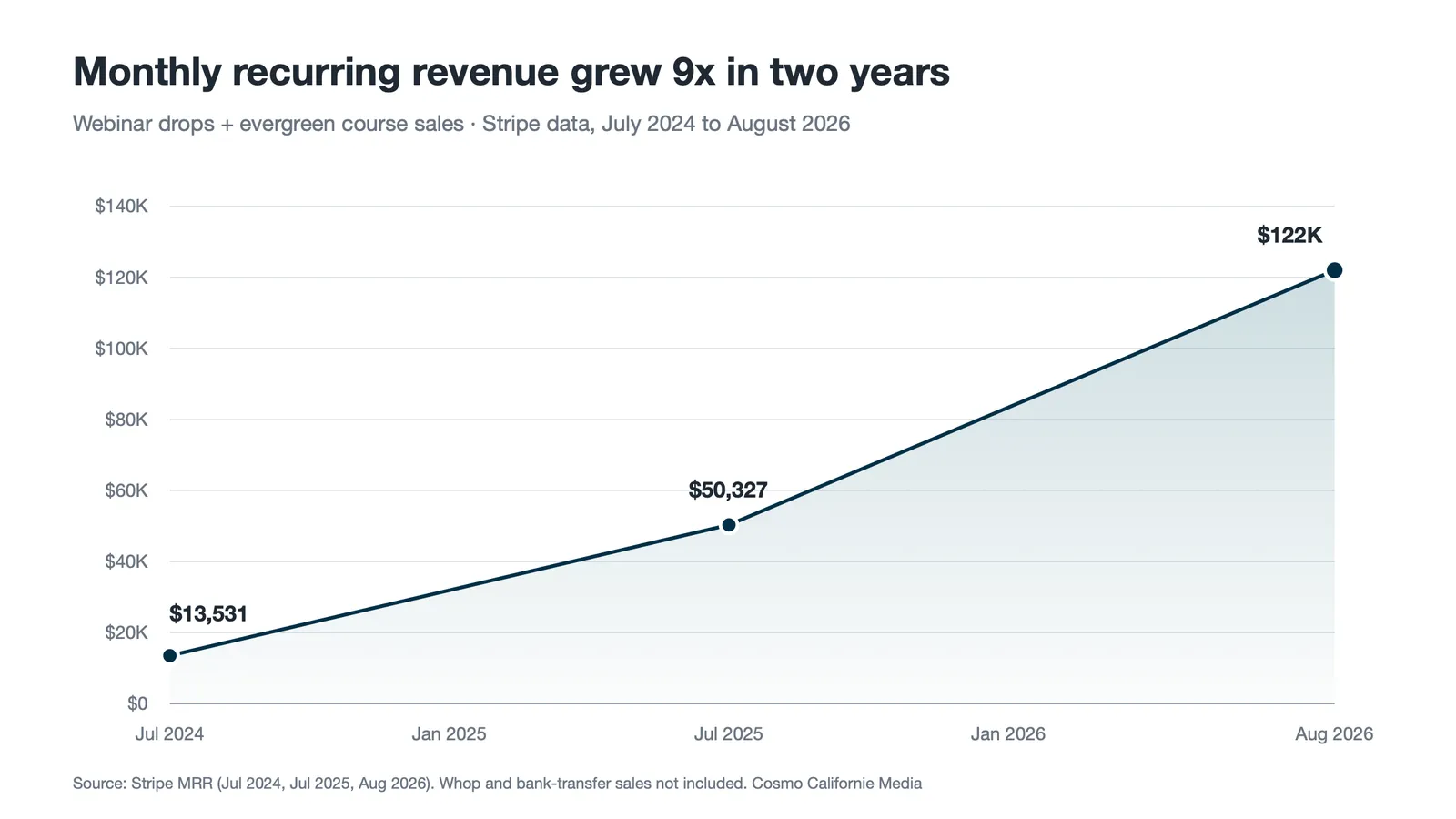
An online education and coaching business grew monthly recurring revenue 9x, from $13,530.56 in July 2024 to $122K in August 2026, running quarterly webinar launches and an evergreen funnel on nearly 30 connected tools. Cosmo Californie Media owned that technical infrastructure end to end for two years at 15 to 20 hours a week, in practice a part-time CTO role, covering payments and course access, the CRM move from Google Sheets to Close, sales-team routing, email and SMS, reporting, and live support during every cart opening. Everything was built without AI.
- Client
- Online education and coaching business (not named)
- Industry
- Online courses, coaching, webinar launches
- Services
- Automation and systems architecture, CRM implementation, payment and access flows, launch support
- Period
- Two years, July 2024 to August 2026
- Tools
- ClickFunnels, Stripe, Whop, Wise, KIT, Brevo, Kajabi, Skool, Close, Zapier, Make, Calendly, Typeform, Hyros, Looker Studio, Slack
- Reported in
- USD, Stripe only (Whop and bank transfers excluded)
Challenges / Opportunities
An online education and coaching business sold its courses two ways. Each quarter it ran a webinar launch, with the cart open for a short window after the live event. Between launches, an evergreen funnel sold the same courses year-round.
Both ran on nearly 30 connected apps, and almost every critical one had a backup. ClickFunnels handled pages and checkout, with a second ClickFunnels account as a backup to the original. Stripe handled payments with Whop as its backup, alongside Wise for bank transfers. KIT sent the email, with Brevo as its backup. Certain purchases granted access to courses in Kajabi, and Skool hosted a free course. The sales team worked from Google Sheets and later Close, and Calendly, Typeform, Hyros, Looker Studio and Slack were also in the stack, all tied together with Zapier and Make.
Every sale passed through that chain. After a buyer paid, they had to be tagged, given access that matched the package they bought, added to the CRM, moved into onboarding emails, and announced to the sales and customer-success teams in Slack. One broken webhook during a cart opening could leave customers without access, send closers after leads who had already bought, or let a failed payment unlock a course.
Sales were also high touch. Each lead worked with a setter and then a closer, assigned round-robin across 3 setters and 5 closers, and automated emails and texts went out looking like they came from the closer assigned to that lead. A lead could never get a message from one closer and then a call from another. Failed payments were one of the biggest hurdles, made harder because sales went beyond online checkout and involved a lot of contact between the sales team and each lead.
With that many apps, backups and hand-offs, the points of failure were numerous, and with most launch revenue landing in a few days each quarter, the business needed someone who owned the whole chain and could fix it live. We built and ran all of it without AI.
Client Results
- 9x MRR: $13,530.56 (July 2024) → $122K (August 2026)
- Gross volume more than doubled two years running: January–July went from $366K (2024) to $733K (2025) to $1.7M (2026), up 100% and then 132%
- 3.9x Webinar Course Drop Day revenue: $60,489 (June 2025) → $235,518 (February 2026)
- Failed payments kept out of the course: $1.86M in failed payment attempts, against $2.0M in successful payments, handled without granting access
- 15–20 hours a week, part-time
All figures are from Stripe alone. Sales through Whop and bank transfers come on top.
The Work We Did / Lessons Learned
We started on the automation side. Over two years we came to own the technical infrastructure end to end: the architecture, the vendors, the costs, access and security, and incident response. In practice it was a CTO role delivered at 15–20 hours a week.
Launch funnels built to be relaunched. Each quarter the full funnel ecosystem was duplicated and adapted for the new event: opt-in, checkout, upsells and confirmation across every product tier. Reusable automation bases were archived after each launch, so the next one started from a proven structure. Abandoned-cart logic moved leads who didn't buy within a set window into the right nurture sequence and pulled them out the moment they purchased.
Payments translated into access. Payment events from Stripe, Whop and Wise/bank transfers automatically granted or revoked Kajabi access based on the exact package bought, and every flow had to work the same whether a sale came through the main tools or their backups. Renewals, upsells, refunds, declined payments, duplicate charges and delinquent subscriptions all had their own handling, and incomplete transactions never granted access. Payment notifications went in real time to the right Slack channels for sales and customer success.
A CRM that grew with the business. The sales team started in Google Sheets, which worked really well for them until the quarterly events reached 15,000 leads. At that point we moved them to Close, migrating the historical data without breaking live workflows. Close was configured with custom fields, custom activities, pipelines and role-specific smart views for setters, closers, coaches and customer success. Leads were scored live as hot, warm, cool or nurture, and reassigned when the team changed. Calendly bookings posted to Slack with the right closer tagged and the lead's budget, call time and notes attached.
Every message from the right closer. Leads were assigned round-robin across 3 setters and 5 closers, and WhatsApp routing spread conversations across the team. Automated emails and texts went out looking like they came from the closer assigned to that lead, so a lead never received a message from one closer and then a call from another. Every assignment and reassignment had to reach every connected system.
Email, SMS and qualification. KIT tags, segments and sequences stayed in sync with purchases, access and CRM status, with Brevo as the backup platform and the SMS channel for launches and events. Budget-based qualification routed each lead into the right sequence and kept the wrong messages from going out.
Reporting and attribution. Hyros tracking and UTM management tied leads back to their source, and lead counts were reconciled across platforms. Setters and closers had KPI dashboards and end-of-day reports in Google Sheets and Looker Studio.
War-room support during cart openings. Before every launch, each automation was stress-tested by simulating purchases, failed payments, upsells and abandoned carts across every tier, before the wider team began its own testing. During cart openings, including evenings and weekends, we were live as traffic hit the funnel, fixing missing notifications, wrong access grants, duplicate leads, webhook failures and sync errors. After each incident the team got a clear status: what broke, what was fixed, and what to keep watching.
Running the stack like a CTO. Plans and usage limits were managed across Zapier, Make, KIT and Zoom, with upgrades raised before limits were hit. High-volume workflows moved from Zapier to Make to cut costs, and we proposed consolidating onto n8n. Credentials ran through 1Password with two-factor authentication and dedicated automation accounts. Every system was documented in Google Docs, Whimsical flowcharts and Loom walkthroughs, and for bug patching and documentation we implemented the same system described in our Zapier and Make scenario maintenance case study. We were the technical point of contact for the founders, sales, coaches and customer success, and coordinated with outside funnel builders and messaging agencies across time zones.
The lesson we took from it: the event and the ads decide how many people are ready to buy, and the infrastructure decides how many of those sales the business actually keeps. That second part is the T in CM(T)O: someone who owns how every system connects, so a growing business can scale and understand how everything ties together.
Results & Lasting Benefits
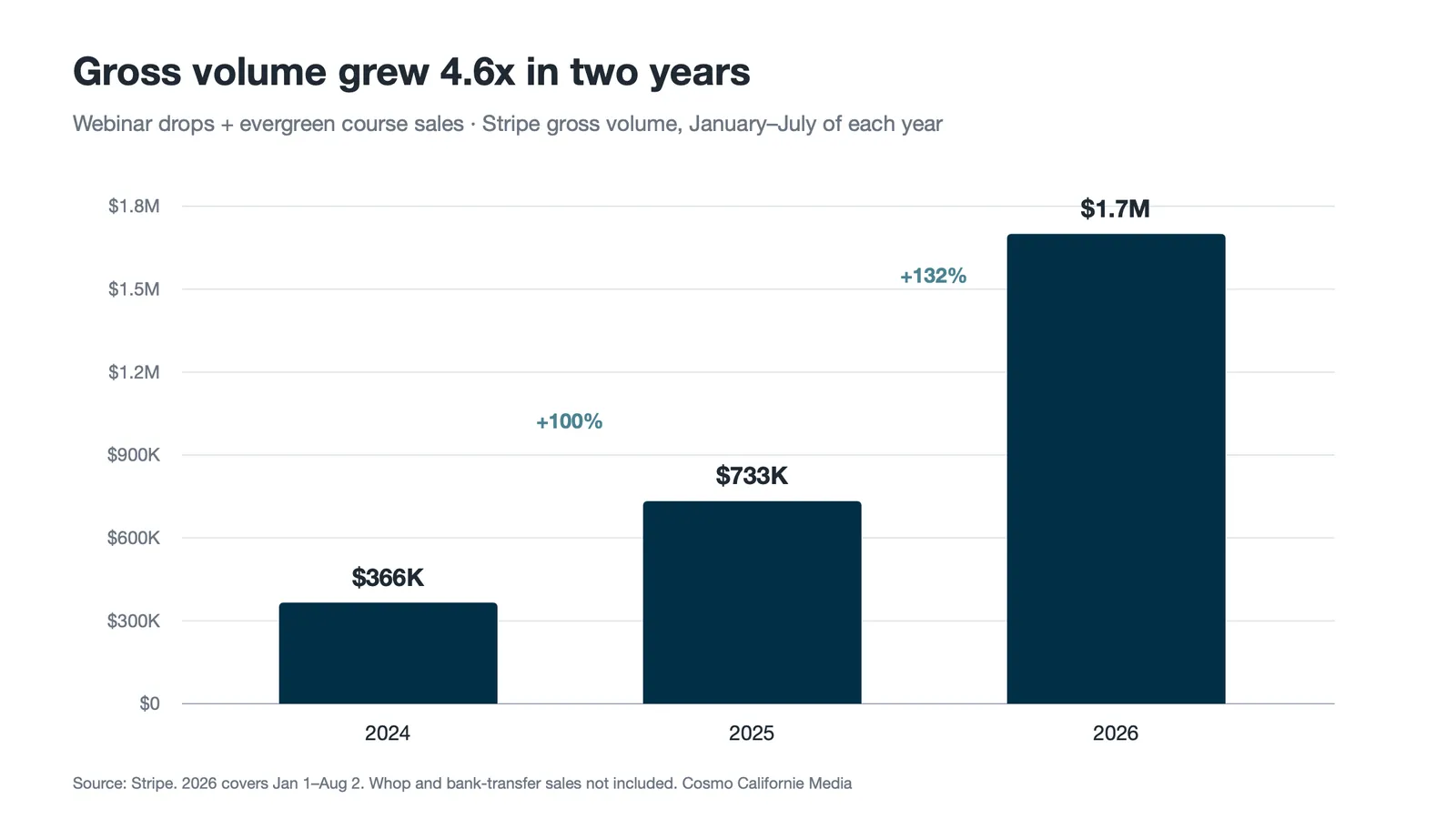
Over the two years, monthly recurring revenue grew from $13,530.56 to $122K, and gross volume more than doubled year over year twice. Webinar Course Drop Days grew with it:
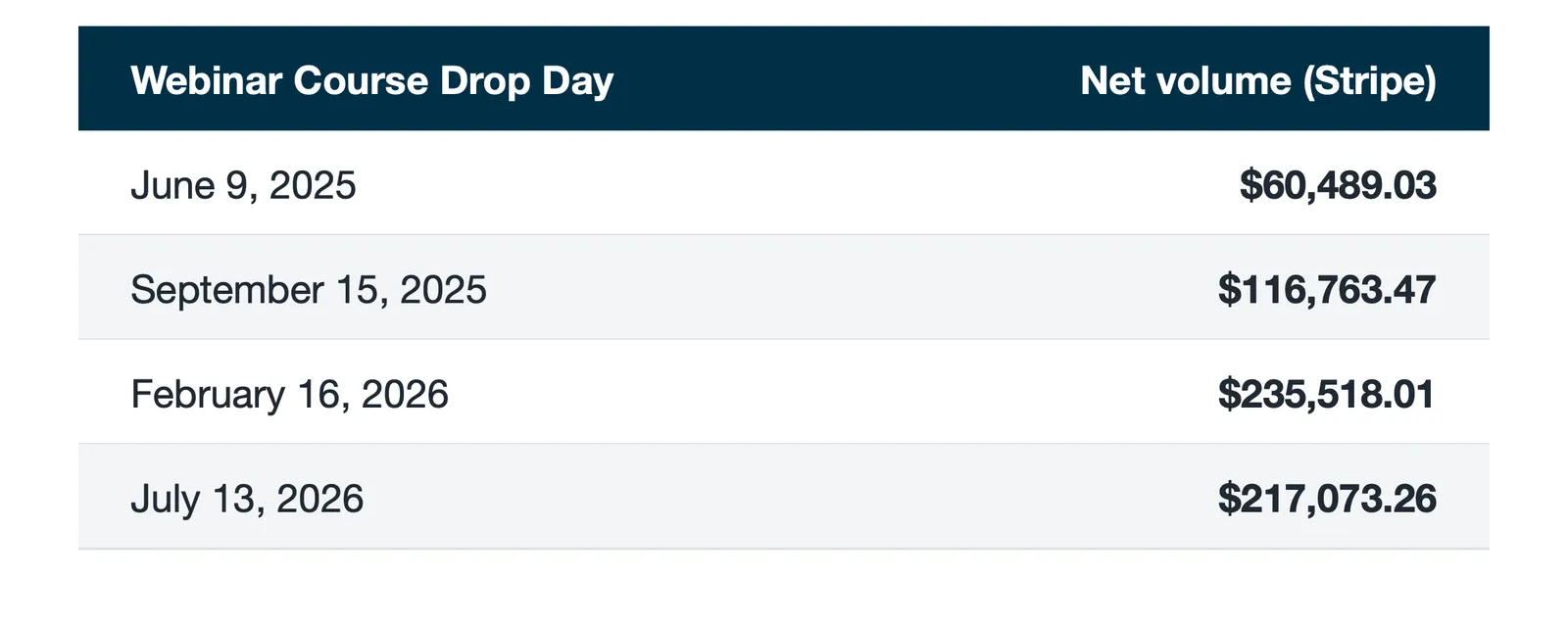
On each of those days almost all the revenue arrived within a few hours, which is exactly the window when a broken webhook costs the most. Webinar attendance and ad spend drove that growth. The infrastructure is what let the business capture it, launch after launch, with every buyer paid, given access, onboarded and handed to the right person on the team.
The load on the back end grew with the evergreen side too. In the 2026 Stripe payments view, failed payment attempts ($1,856,076.36) came close to successful payments ($2,003,485.66), and every one of them had to be caught before it granted access to a course. Refunds stayed at $29,893.27, about 1.5% of successful payments.
Everything above was built without AI, and the same approach still handles a large share of what growing businesses need today. We bring AI into client systems where it adds real value, and we keep rule-based work in n8n, Make or Zapier, where every run is logged step by step and anyone on the team can see exactly what happened and why. That record is often harder to get from an AI routine, which is why choosing the right tool for each job matters. If you're bringing AI into your tech stack, it's worth asking whether you're hiring a vibe coder or someone with proven industry expertise who knows when AI is the right tool and when a well-built workflow will serve you better. The best engineers have a deep understanding of physics, because engineering is the application of physics. AI is the next layer on top of automation, and the people who build with it well are the ones who understand the foundation.
If your business depends on a stack nobody fully owns, shoot me a message and we can map out what it's already capable of and where to take it next.
Book a CallQuestions about this case study
Where do the revenue numbers come from?
All figures are from Stripe alone. Monthly recurring revenue went from $13,530.56 in July 2024 to $122K in August 2026, and gross volume for January to July went from $366K in 2024 to $733K in 2025 to $1.7M in 2026. Sales through Whop and bank transfers come on top, so the totals understate the business.
Did the automation cause the growth?
The page is careful about this. Webinar attendance and ad spend drove the growth, and the infrastructure is what let the business capture it, launch after launch, with every buyer paid, given access, onboarded and handed to the right person. On a Webinar Course Drop Day almost all revenue arrives within a few hours, which is exactly when a broken webhook costs the most.
What did the two-year engagement cover?
Launch funnels rebuilt each quarter from archived automation bases, payment events from Stripe, Whop and Wise translated into Kajabi access, failed and incomplete payments kept out of the course, the sales CRM moved from Google Sheets to Close once events reached 15,000 leads, round-robin routing across 3 setters and 5 closers with every message sent as the assigned closer, KIT and Brevo email and SMS kept in sync, Hyros and UTM attribution, KPI dashboards, and war-room support during cart openings, including evenings and weekends.
How were failed payments handled?
In the 2026 Stripe payments view, failed payment attempts ($1,856,076.36) came close to successful payments ($2,003,485.66), and every failed or incomplete transaction had to be caught before it granted access to a course. Renewals, upsells, refunds, declined payments, duplicate charges and delinquent subscriptions each had their own handling, and refunds stayed at $29,893.27, about 1.5% of successful payments.
Was AI used anywhere in this system?
No. Everything was built and run without AI, on rule-based workflows in Zapier and Make where every run is logged step by step. We bring AI into client systems where it adds real value and keep rule-based work in n8n, Make or Zapier, because that record of what happened and why is often harder to get from an AI routine.
Working with us.
Let's figure out where your growth is getting stuck.
Book a discovery call with Sonny — a focused conversation about your business and where the opportunities are.
Book a Discovery CallMore case studies
The Value of Call Tracking When Running Paid Ads
Booked appointments rose from 98 to 141 a quarter and cost per booking fell 26.5% for a local medical practice once call tracking fed Google Ads.

Sales System for Startup
MRR grew 2.7x to $67,250 after three years of flat revenue, from a $10,900 total investment in a CRM-driven sales system.
LCRM: Lead Tracking System
One tracking system follows every lead from first contact to procedure start, so each channel is credited across the customer lifetime.