The Value of Call Tracking When Running Paid Ads
A local medical practice cut its cost per booked appointment by 26.5% in one quarter, from $90.37 to $66.44, and booked 141 appointments against 98 in the quarter before, roughly $94,600 in added booked revenue at $2,200 per scheduled appointment. The ads, budget and landing pages stayed the same. Cosmo Californie Media changed the definition of a phone conversion to first-time callers who stayed on the line more than 30 seconds, using a call tracking tool that costs between $50 and $250 a month.
- Client
- Local medical practice (not named)
- Industry
- Healthcare, appointment-based practice
- Services
- Call tracking setup, conversion tracking, paid search management
- Period
- February to July 2026, two quarters compared
- Tools
- Call tracking with dynamic number insertion, Google Ads, the practice's CRM
- Reported in
- USD, measured in the practice's CRM
A local medical practice we manage cut its cost per booked appointment by 26.5% in a single quarter and added roughly $94,600 in booked revenue over that period — by implementing a unique solution from a tool that costs between $50 and $250 a month.
Nothing changed about the ads, the budget, or the landing pages. What we changed was the definition of a conversion.
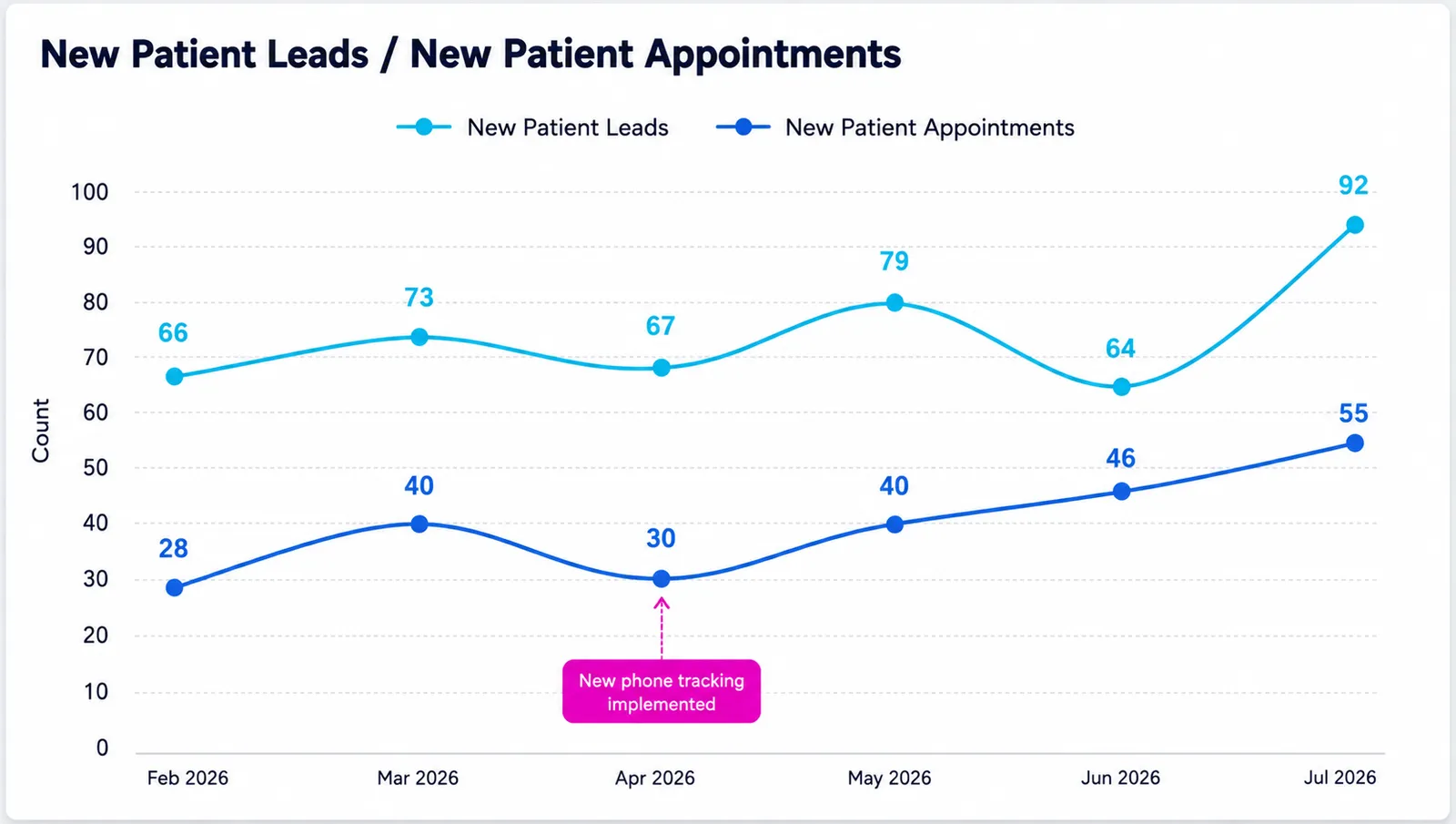
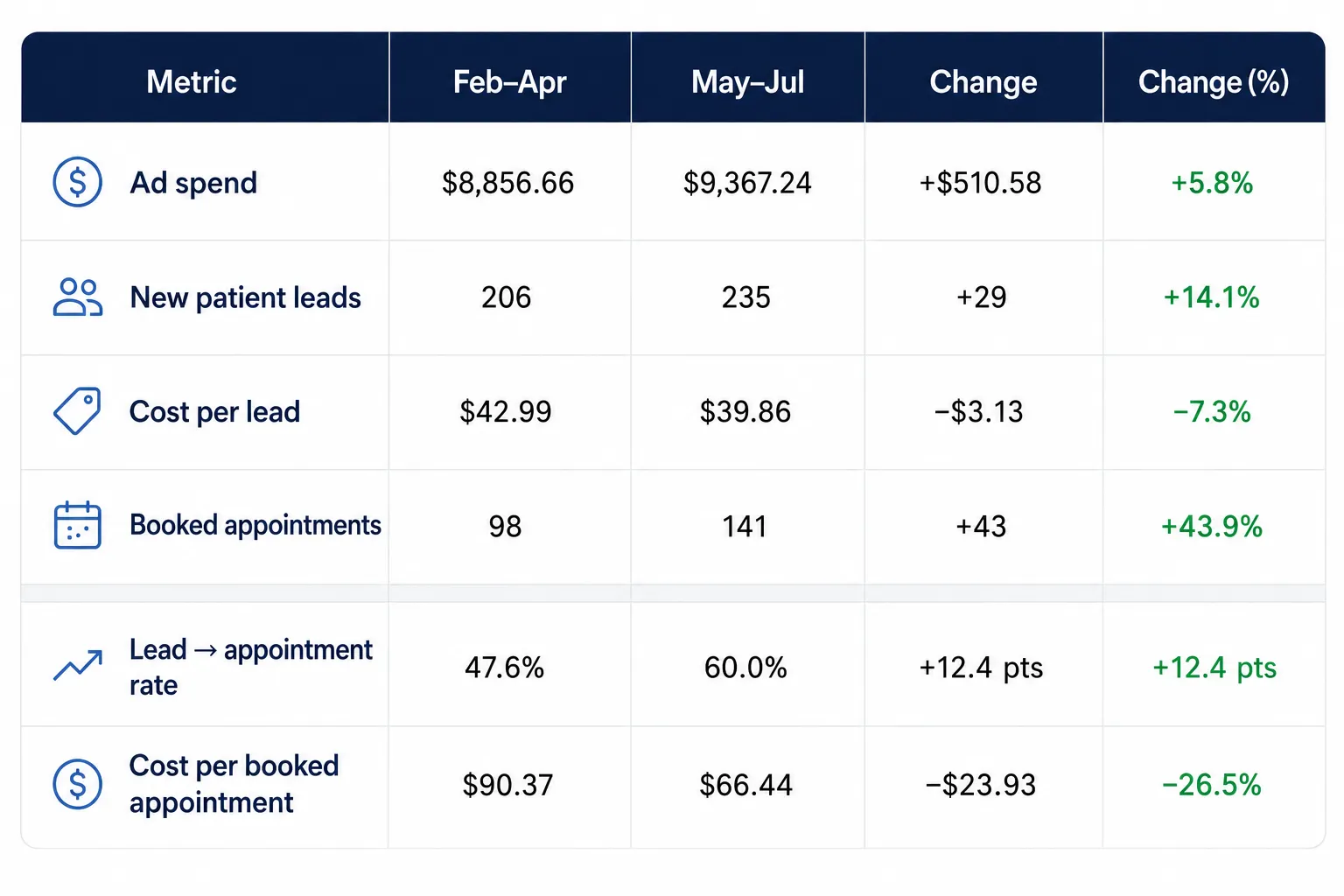
Paid search account. Both periods measured in the practice's CRM. April is counted in the "before" period even though the change went live on the 22nd, which understates the result.
At an average value of $2,200 per scheduled appointment, the practice went from 32.7 appointments a month to 47 — roughly $31,500 in additional monthly booked value produced by a measurement change.
What we Adjusted
The account had been counting phone calls the way most accounts do: phone clicks and total calls, with no distinction between a new patient and someone confirming next Tuesday's appointment. That isn’t ideal (I’ll explain more later).
However, there exist call tracking platforms that assign a dynamic phone number to each visitor and stitch the resulting call back to its source — channel, campaign, landing page, and often the exact keyword. That fixes attribution. In addition, these platforms allow you to segment calls with multiple filters.
First-time caller versus repeat caller. The platform knows whether it has seen the number before. An existing customer calling to reschedule is good for the business and poisonous for the bidding algorithm, because you end up paying to acquire people who already found you.
Call duration. A call lasting eleven seconds is a hang-up, a misdial, or a robocall. A call running past thirty seconds is a human with a question. A minimum duration threshold strips the noise floor out of your call data with zero manual review.
Combine these two filters, and you have a call type that means something specific: a new person, with real intent, who stayed on the line long enough to have a conversation. We made this the new phone call conversion in the account and deleted phone clicks.
How can a measurement change move revenue so much?
Every major ad platform now bids on your behalf. (Manual bidding is still possible, but all platforms intentionally charge you more in the auction if you manually bid, putting you at a major disadvantage). Google Smart Bidding, Meta's automated bid strategies, LinkedIn's optimized delivery — all of them price each auction by studying the conversions you report back, then go looking for more people who resemble the converters. A conversion to these platforms is essentially an iterative, always updating ICP (Ideal Customer Profile)
Key Note on this: The ad platforms are completely indifferent to whether those conversions are any good for your business.
Feed a platform "someone tapped the call button" and it finds you people who tap call buttons. Feed it undifferentiated calls and it learns the profile of everybody who dials your business, including the existing customers who were always going to call as well as the vendors pitching you SEO services. The algorithm does exactly what you ask.
This is why call tracking thought of as a reporting tool is the wrong lens. The compounding value of these tools arrives the moment the filtered conversion becomes a primary conversion in your account— from that day forward, every auction is priced against a cleaner definition of a customer.
If your business sells anything above $117, most prospects want to talk to a human before they buy. (*) That makes the phone your highest-intent channel and, across most ad accounts, the one teaching the algorithm the worst lessons.
What call tracking tool?
There are two I recommend split mostly by geography:
CallRail — the strongest option for the US, Canada, UK, and Australia. Attribution accuracy is consistently reliable and the support is the best in the category.
Nimbata — the better fit for European clients, with strong number coverage across the region.
Both cover the fundamentals: dynamic number insertion, keyword- and campaign-level attribution, first-time caller identification, duration filtering, conversion push into your ad platforms, call recording, form tracking, number privacy, and CRM integration.
I hold partner status with both, so the links above get you a discount on public pricing. Existing clients get an additional $50 off our monthly work together.
The part worth remembering
Every conversion you achieve on your ad platform is a live optimization to your campaign. It is a feedback loop and a pat on the back to the bidding algorithm saying “Good Job”. Send better examples and the machines buying your traffic make better decisions on every auction, every day. Don’t do it and you could be missing out on a significant uptick in revenue for your company. I say this because the example above is one of many clients we’ve switched over to call tracking and seen strong results. Shoot me a message if you have any questions.
Questions about this case study
How can changing a conversion definition increase booked appointments?
Every major ad platform bids on your behalf by studying the conversions you report back and looking for more people who resemble them. When the account counted phone clicks and every call, it was learning from existing patients rescheduling, robocalls and vendors. Once the primary phone conversion became a new caller who stayed on for more than 30 seconds, every auction was priced against a cleaner definition of a customer, and the lead-to-appointment rate went from 47.6% to 60.0%.
What are the two call tracking filters?
First-time caller versus repeat caller, because the platform knows whether it has seen the number before, and call duration, because a call under 30 seconds is usually a hang-up, a misdial or a robocall. Combined, they define a new person with real intent who stayed on the line long enough to have a conversation. That became the new phone conversion and phone clicks were deleted.
What were the exact before-and-after numbers?
Cost per booked appointment fell from $90.37 to $66.44, booked appointments rose from 98 to 141, and new-patient leads went from 206 to 235 with cost per lead down from $42.99 to $39.86. Ad spend was close to flat, $8,856.66 against $9,367.24. April counts in the before period although the change went live on the 22nd, which understates the result.
Which call tracking tool does Cosmo Californie recommend?
CallRail for the US, Canada, UK and Australia, and Nimbata for European clients. Both cover dynamic number insertion, keyword and campaign attribution, first-time caller identification, duration filtering, conversion push into the ad platforms, call recording, form tracking and CRM integration. Sonny holds partner status with both, so the links on the page carry a discount, and existing clients get $50 off monthly work.
Does this only apply to Google Ads?
The same mechanism applies to every platform with automated bidding, including Google Smart Bidding, Meta's automated bid strategies and LinkedIn's optimised delivery. If a business sells anything above about $117, most prospects want to talk to a human before they buy, which makes the phone the highest-intent channel and, in most accounts, the one teaching the algorithm the worst lessons.
Working with us.
Let's figure out where your growth is getting stuck.
Book a discovery call with Sonny — a focused conversation about your business and where the opportunities are.
Book a Discovery CallMore case studies

What Is a CM(T)O and When It Is Right for Your Business
Why so many fractional CMO engagements fall short, and the revenue systems a CM(T)O owns once growth becomes a coordination problem.
Using a Unified Looker Studio Dashboard to Reduce Client Churn
One dashboard across website conversions, CallRail and Google Ads for a home-restoration marketing agency, which was later sold to private equity.

In 2025 We Set Out to Help 100 Businesses: What We Discovered
What we learned working with businesses across North America and Europe in 2025: white label, B2B lead gen, tracking, automations and AI.