Fractional CM(T)O: one person who owns how your growth works
A fractional CM(T)O led by Sonny Hughey for businesses between $250K and $5M in revenue: one person who owns attribution, the marketing-to-sales handoff, the vendors and the numbers, part-time.
Cosmo Californie Media provides a fractional CM(T)O, a Chief Marketing (and Technology) Officer, for businesses between roughly $250K and $5M in annual revenue. Sonny Hughey, the agency's founder, joins the business part-time and owns the systems that make revenue repeatable: tracking and attribution, the handoff between marketing and sales, the CRM, and accountability across every agency, freelancer and vendor. The engagement is hands-on and embedded, with a guaranteed monthly base of hours billed at $60 an hour, and it is capped at two companies in 2026.
- Who it is for
- Owner-run businesses, $250K to $5M in revenue, already using agencies or freelancers for part of their marketing
- Led by
- Sonny Hughey, founder, with the Cosmo Californie team behind him
- Typical engagement
- A guaranteed monthly base of hours, a weekly meeting, launch months scoped separately
- Billing
- $60 an hour against the guaranteed base; audit first
- Availability
- Two companies in 2026
What is a fractional CM(T)O?
A CM(T)O is a Chief Marketing (and Technology) Officer. The role exists because, somewhere past early traction, marketing stops being an execution problem and becomes a coordination problem. Leads arrive from several channels with different levels of intent, an agency runs the ads, a freelancer runs the email, the CRM was set up by whoever was available, and the reports from each of them disagree. Growth is no longer limited by ideas or effort. It is limited by the fact that nobody owns how the pieces fit together.
A fractional CM(T)O takes that ownership part-time. Sonny wrote up the thinking behind the role, where it came from and when it is premature in What Is a CM(T)O. The short version is that a CEO owns revenue outcomes and a CM(T)O owns the systems that make those outcomes repeatable.
What does the CM(T)O actually do each week?
The work is operational, with Sonny inside the business rather than advising it from outside. In a typical month that covers:
- Revenue infrastructure. Tracking, attribution and the conversion definitions every ad platform learns from, so the numbers the business runs on can be trusted. This is usually where we start, because a bad lead definition quietly steers every campaign in the wrong direction.
- The marketing-to-sales handoff. How a lead is routed, who follows up, how fast, and what the CRM records along the way, so demand that is already paid for turns into customers.
- Vendor and specialist accountability. Agencies, freelancers and internal staff measured against the same KPIs, with one dashboard showing what each channel costs and returns. We manage the specialists so the owner does not have to referee them.
- Hiring support and direction. Scoping roles, sitting in on interviews, and giving the marketing team a clear set of priorities each week.
- A weekly meeting, roughly an hour, with the preparation and follow-through that make it count.
Sonny also brings the technical side of the T. Over two years he ran the entire back end of an online education business, nearly 30 connected tools, as a part-time CTO, while its monthly recurring revenue grew 9x. The same discipline applies to a marketing stack.
How do you know if you need one?
The pattern we see most often in businesses between $250K and $5M is that the leads are there and the team is working, and revenue still does not scale the way it should. Reports conflict across platforms. One channel performs while another underdelivers and nobody can say why. Follow-up varies by channel. Decisions slow down because the numbers are debated instead of trusted. Those are coordination problems, and they are the signal that the leadership layer needs to change before more money goes into channels.
There are also stages where this role is premature. If the business is still validating its core offer, if growth runs through a single channel with little complexity, or if fulfilment and sales follow-up are unstable, speed and iteration matter more than structure. We will say so on the discovery call.
What does it cost?
The engagement runs on a guaranteed monthly base of hours billed at $60 an hour, so the business knows the floor each month. A weekly meeting works out at about two and a half hours including preparation and follow-up actions. Launch months, where the CM(T)O is building rather than steering, are scoped separately in advance. Where it fits, part of the fee is tied to year-over-year revenue growth, so the CM(T)O owns the revenue number alongside the owner. Every engagement starts with an audit, and the audit fee is credited against the first months if we continue together.
Because the role is hands-on, it is limited to two companies in 2026. If the slots are taken, the audit and the individual services below are still available.
How the engagement fits with our other services
The CM(T)O owns the plan and the accountability. The execution can come from your existing vendors, from our team, or from both. Most engagements lean on our tracking and attribution work first, then paid acquisition and CRM and automation where the audit shows the gaps.
If your marketing has outgrown the systems behind it and nobody owns the full picture, shoot me a message and we can map out what a CM(T)O would take on first.
Book a CallQuestions about this service
What is the difference between a fractional CMO and a fractional CM(T)O?
A classic CMO role was shaped around brand, messaging and top-of-funnel demand. A CM(T)O adds ownership of the technology that revenue now depends on: the CRM, analytics, attribution, automation and the ad platforms, and how they connect to sales. The person has to be technically fluent enough to design and govern those systems, not to write code.
How many hours a month does the engagement take?
A guaranteed monthly base of hours is agreed up front, with a weekly meeting of about an hour plus the preparation and follow-up that go with it. Launch months need more and are scoped separately. The exact base depends on how many channels, vendors and systems are in play, and it is set after the audit.
Is this advisory work or hands-on?
Hands-on and embedded. Sonny sits inside the business, drives marketing direction, supports hiring, manages contractors and agencies, and goes into the accounts and systems himself when something needs fixing. Advisory-only engagements are available by the hour, but that is a different service.
Which businesses is it designed for?
Owner-operated businesses between roughly $250K and $5M in annual revenue that already use agencies or freelancers for part of their marketing and have more than one channel in play. Our clients in this range have included healthcare practices, B2B SaaS, training and education, home services, e-commerce and marketing agencies.
Why is it capped at two companies?
Because it is Sonny's own time and the role only works if he is genuinely inside the business each week. Two engagements alongside the agency's existing clients is the limit at which that stays true.
How does the engagement start?
With a discovery call, then an audit of tracking, channels, CRM and the sales process. The audit produces a written plan of what to fix first and a scope for the CM(T)O role, and its fee is credited against the first months if we go ahead.
Working with us.
Let's figure out where your growth is getting stuck.
Book a discovery call with Sonny — a focused conversation about your business and where the opportunities are.
Book a Discovery CallCase studies for this service

What Is a CM(T)O and When It Is Right for Your Business
Why so many fractional CMO engagements fall short, and the revenue systems a CM(T)O owns once growth becomes a coordination problem.

In 2025 We Set Out to Help 100 Businesses: What We Discovered
What we learned working with businesses across North America and Europe in 2025: white label, B2B lead gen, tracking, automations and AI.
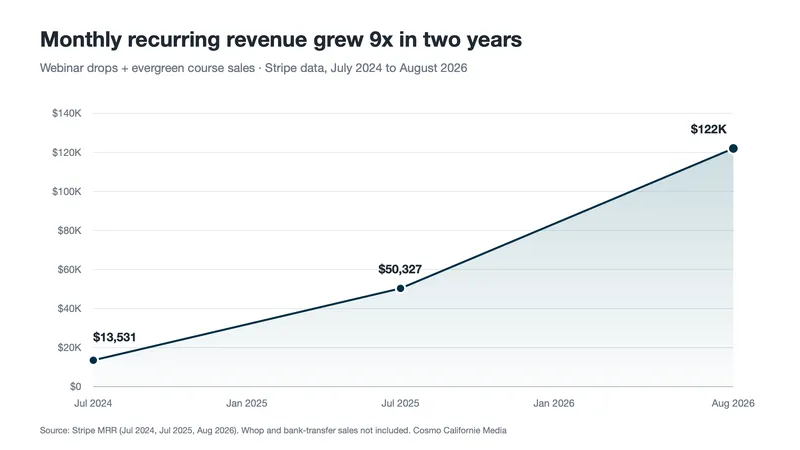
Webinar Drops + Evergreen Automation Infrastructure
MRR grew from $13,531 in July 2024 to $122K in August 2026 for an online education business running quarterly webinar launches on nearly 30 tools.