A medical clinic that had used several agencies over six years had a Google Ads account full of cheap leads that never became patients. Cosmo Californie Media found six conversion types where medical accounts normally have two to four, with repeat callers and calls under 30 seconds counted as leads. After switching to first-time callers over 30 seconds only, reported conversions fell and cost per conversion rose, while monthly new patients tripled, cost per new-patient show dropped from over $500 to $269, and the account returned 6.69x on $9,413 of ad spend.
- Client
- Medical clinic (not named)
- Industry
- Healthcare
- Services
- Google Ads audit and account overhaul, conversion tracking
- Period
- 6 months
- Tools
- Google Ads, call tracking
- Reported in
- USD
Challenges / Opportunities
This client was a longtime user of Google Ads and had worked with several marketing agencies over the previous 6 years. They had worked with agencies in the past who gave our industry a bad rep. They didn't get clear results: the account appeared to be doing well with a lot of leads AND at an amazingly low cost/lead, but they didn’t see it translate to the real world - the amount of new patients coming into the office was not where they wanted.
This presented the challenge of bringing clarity to their lead generation efforts, us wanting to get the best results possible, and also making sure to show the client that not all agencies are like their past experiences.
The Work We Did / Lessons We Learned
In our initial audit we noticed that there were 6 types of conversions in the google ads account. Typically in the medical space, there are only 2-4 conversion types:
- Phone Call
- Contact Form Fill (on website)
- Top of Funnel Form Fill (typically a quiz)
- Promotion / Unique Campaign Conversion
In addition, we saw that phone calls were being manipulated in the account to appear to be performing better than in reality. We only track “first time callers”, which are leads that haven’t interacted with the business before, and these calls need to be over 30 seconds long. The phone calls counted as leads in the account were not refined in this way. Repeat callers and under 30 second calls counted as conversions.
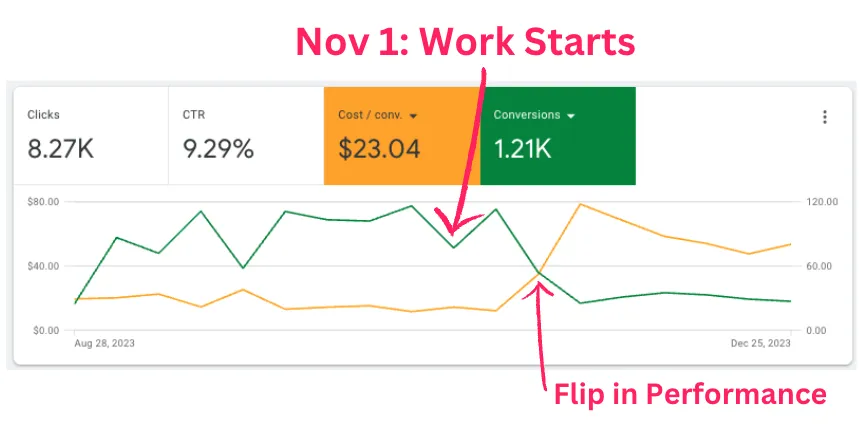
We implemented our robust conversion tracking in the account and as you can see from the image (at the top), our cost/conversion went UP and the number of conversions went DOWN. At first glance, someone would say that the performance got worse. But we know that the performance beforehand was inflated - they did not have quality data, and were OVER COUNTING. You will see in our results below that the number of new patients coming into the office went up after we made our changes.
Results & Lasting Benefits
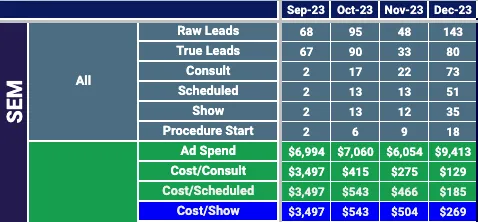
We were able to 3x the monthly new patient volume for this clinic. While Google showed that the cost/conversion (lead) went up, in reality it went down by 6.8% (see below). And the bigger impact was on LEAD QUALITY. Google works in such a way, where its algorithm thinks “a conversion is a good thing”. So if you feed google bad conversions, it won’t know it’s a bad conversion, and will just try to get MORE of that conversion. What ends up happening is a vicious cycle of more and more bad leads that don’t translate into real customers. Not only did we decrease the lead cost, we decreased the cost/new patient by more than 2x (Over $500/new patient show to $269/new patient show) resulting in a 6.69x Return on Ad Spend.
This case study highlights the importance of data quality in the ad account. What is happening in the account doesn’t always translate to what is happening in reality. With a physics degree, and a decade of experience working the research and development industry, I bring a discerning eye to your search engine account delivering high quality conversions.
Questions about this case study
Why did conversions go down after the overhaul?
Because the old conversions were over-counted. The account treated repeat callers and calls under 30 seconds as leads, so the dashboard looked excellent while the clinic saw few new patients. Once only first-time callers over 30 seconds counted, Google showed fewer conversions at a higher cost, and at the same time real new patients tripled. The real cost per lead fell 6.8%.
How many conversion types should a medical Google Ads account have?
Usually two to four: a phone call, a contact form fill, a top-of-funnel form such as a quiz, and sometimes a promotion or campaign-specific conversion. This account had six, which is one of the first things an audit looks at, because every extra or loosely defined conversion teaches the bidding algorithm to find more of the wrong people.
What were the results in revenue terms?
Between $54,000 and $72,000 in revenue on $9,413 of ad spend, a 6.69x return on ad spend. Cost per new-patient show went from over $500 to $269, and the clinic's monthly new patient volume tripled.
What is the lesson for other accounts?
Google's algorithm treats every reported conversion as a good thing. Feed it bad conversions and it will find more of them, in a cycle of leads that never become customers. What is happening in the account does not always match what is happening in the business, so data quality in the ad account comes before optimisation.
Working with us.
Let's figure out where your growth is getting stuck.
Book a discovery call with Sonny — a focused conversation about your business and where the opportunities are.
Book a Discovery CallMore case studies

Zap and Make Automation Scenario Maintenance
Campaigns launch 12 days faster after we audited and standardised the Zapier and Make scenarios behind a marketing agency's client work.

Unseen Costs When Not Using a Google Ads Professional
After a clinic moved Google Ads in-house, cost per lead rose 125% and $5,600 in revenue was lost against $1,500 saved in fees.
Google Ads Management
A 2.34x ROAS across several countries and languages for an optical eyewear e-commerce brand, with $634,000 in revenue in July 2024.