Unseen Costs when not using a Google Ads Professional
After about a year with Cosmo Californie Media, a business took its Google Ads management in-house to save the fee. Twelve weeks later conversions were down 21.6% overall and decelerating each week, with the final two weeks down 42% on 31% more spend than the last two weeks of our management. At about $160 of attributed revenue per conversion, the 35 lost conversions cost $5,600 against $1,500 saved in fees, a net loss of $4,100, or about $50 a day.
- Client
- Service business, former Google Ads client (not named)
- Industry
- Local services
- Services
- Google Ads account review after management stopped
- Period
- 12 weeks compared with the same period before
- Tools
- Google Ads
- Reported in
- USD
Challenges / Opportunities
It can be tempting to cut advertising support costs as a business owner. Advertisers in general gets a bad rep, which to be honest is mostly deserved. The world of marketing has a history of failing to show in dollars and cents how their efforts result in real business for their clients.
Before the internet, it was simply difficult to do as there was no real way to collect the data we can today. But with the dawn of the internet and now digital marketing playing a major role in every business, the industry as a whole still fails to highlight how dollars spent on Facebook or Google Ads results directly in product purchases or new paying clients. All the while our social feeds are filled with “digital entrepreneurs” spread out on a lounge chair, nestled next to soft splashing waves - laptops slightly off screen in the background - and claiming “anyone can do what they do, it is passive, it is so easy!”
As a business owner, how could you not immediately feel that a freelance marketer or agency is taking advantage of you, and just like your feed tells you, do this job yourself? I get it- and while it may not seem to be the case, the truth is that there does exist a group of passionate marketers and consultants who are in the trenches every day, moving the industry forward, and bringing real results for their clients. And what they do isn’t passive, it ain’t that easy, and as the internet becomes more saturated with products and services, and the advertising platforms become more and more restrictive, advertising without professional support can be the biggest trap of them all.
Our Case Study
Today I have a specific case study that shows the cost of “going at it alone”. We worked for a business for about a year improving their customer generation efforts. At a point in time, they judged that our work was sufficient, and maintaining the campaigns would be more cost effective to bring in house.
After several months the client reached back out to me with some questions about the account and I took a look inside. What I found was nothing extreme. There was no raging fire that needed to be put out in the account. But what I did see was an unmaintained wound that was slowly bleeding.
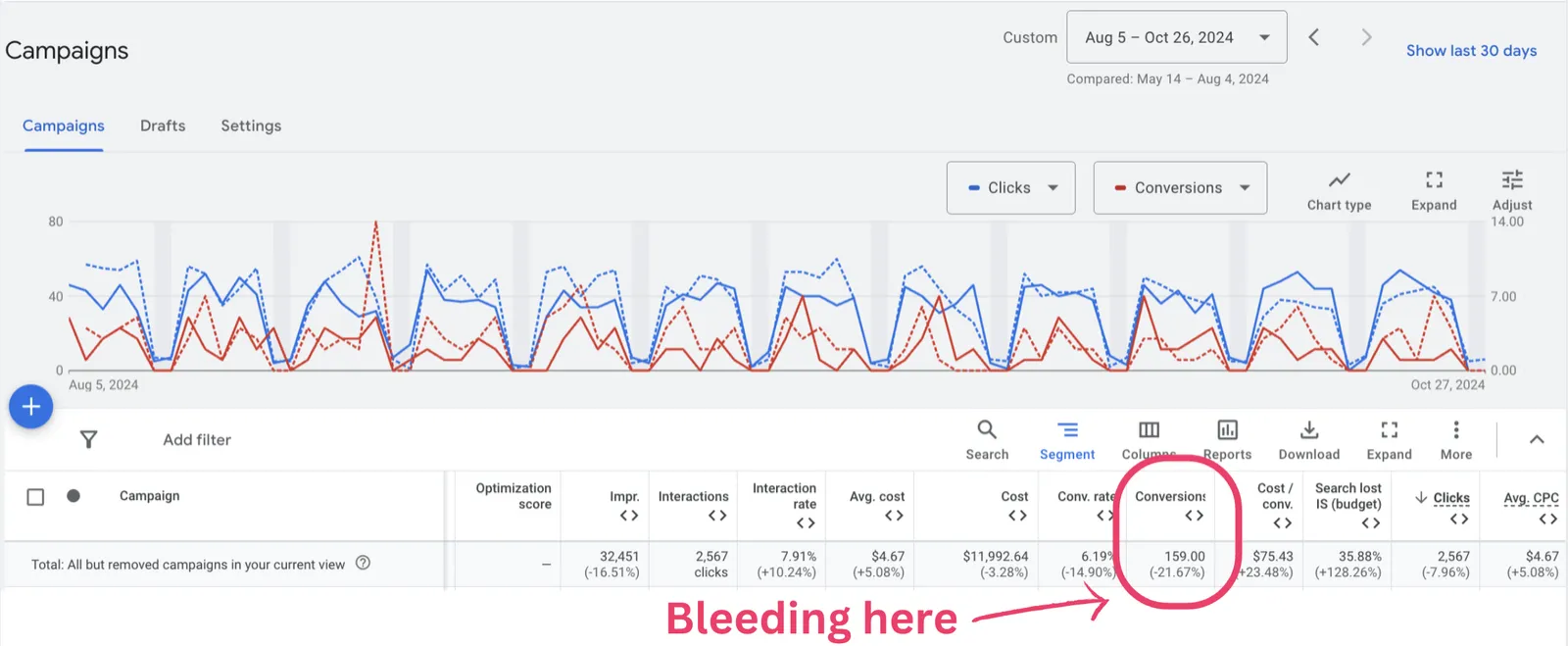
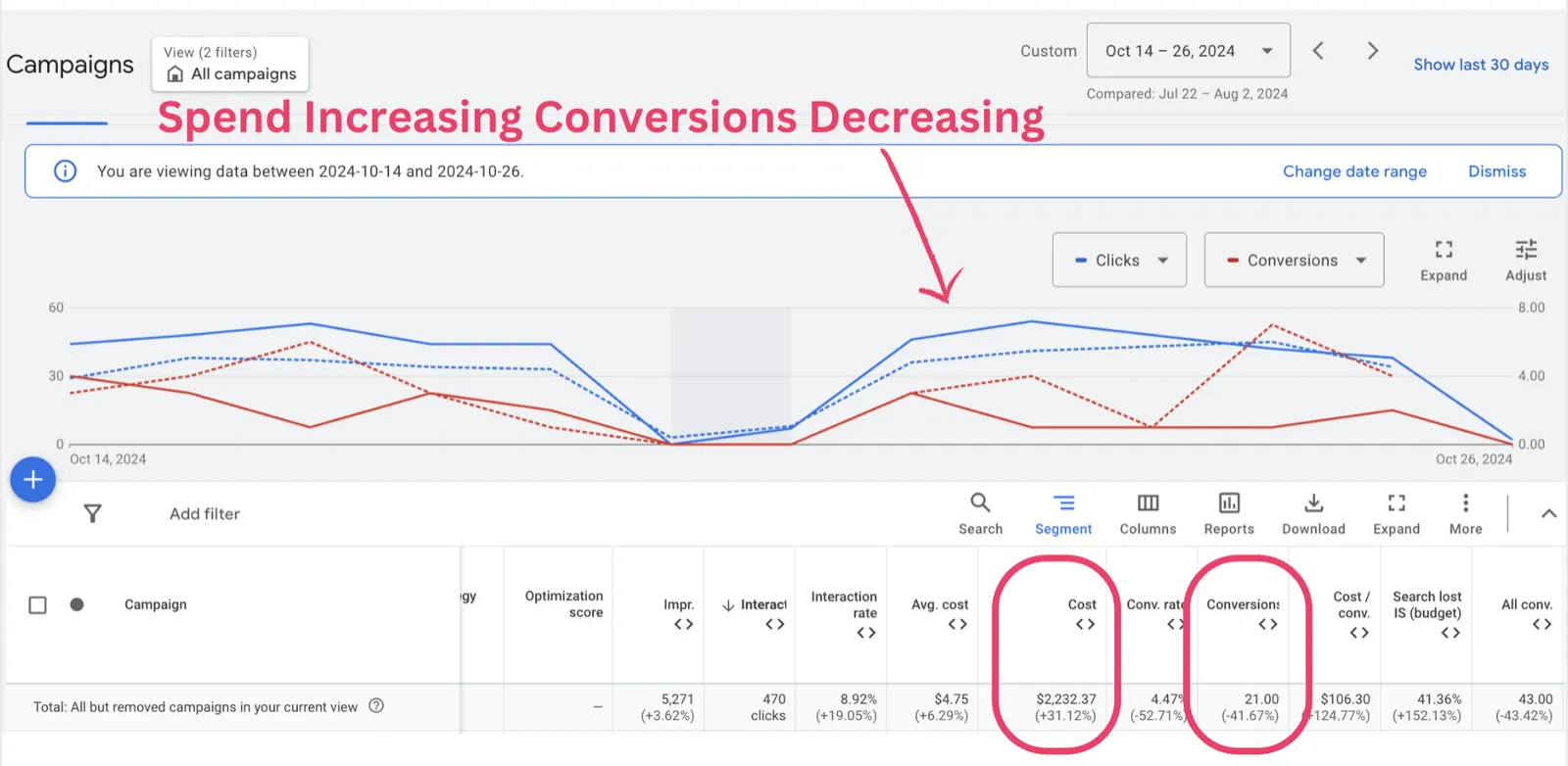
Comparing the time since we stopped services vs the same period of time before we parted ways, they now had a drop in conversions of 21.6%. But this didn’t tell the whole story. As I dug deeper, I found that conversions were decelerating with each week that passed having slightly less conversions than the previous week. Comparing the final two weeks of our support vs the most recent two weeks they had a drop in conversions of 42% and an increase in spend of 31% a negative 73% swing!
One conversion for this account is valued at approximately $160. That means on average, over the year that we managed the account, for every lead generated, the business would see $160 in attributed revenue. The period in which we were not providing services (12 weeks) the 21.5% drop in conversions resulted in 35 less conversions. This equated to $5,600 in revenue loss for the business. Our management fee for this client over that time would have been $1500. So while the business did save on our monthly fee, the loss in business revenue proved more damaging at a $4,100 difference, or $50 loss each day since service stopped.
What Moves the Needle
When it comes to Google Ads management, you must be active in the account. Due to the extensive experience my team and I bring to the table, we’ve developed daily, weekly, and monthly checks that are crucial for catching not only big problems, but sliding performance before it makes an impact. These checks leverage hundreds of data points, some that Google provides freely, others that it does not, and which are collated, manipulated, and visualized via detailed dashboards. The team has been trained on how to interpret this data and and the impact it has for the future performance of the account.
As a past engineer and physicist, I’ve implemented the Standard Procedure into my daily workflow. By formulating hypothesis from our checks and running targeted experiments to we are able to combat underperformance and capitalize on overperformance.
In the end, these actions look remedial in the account, but are what move the needle in the positive direction for our clients’ business:
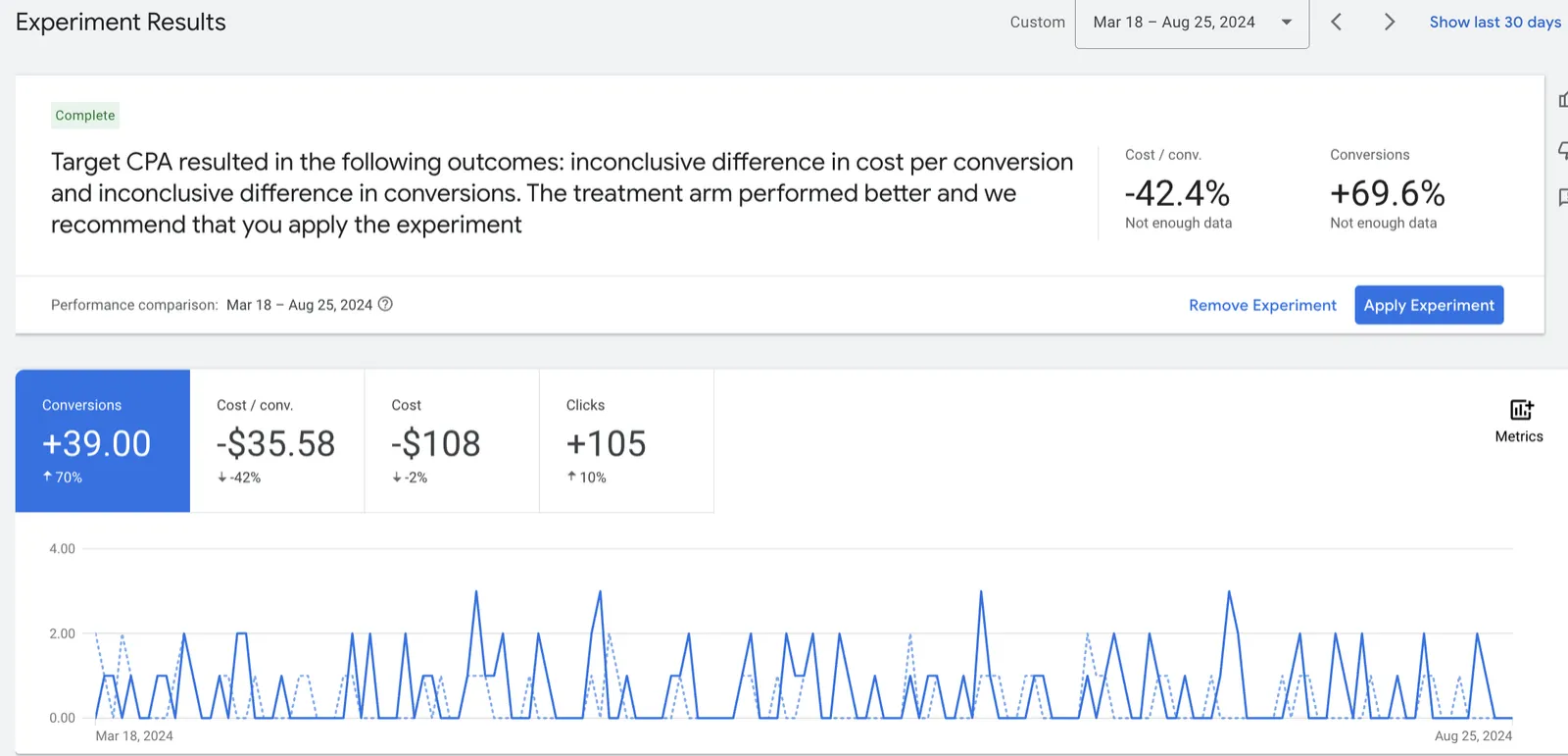
What we found, for this particular case, is that the client made some changes in the account, but simply wasn’t active enough. Existing experiments we had ran, that proved to be affective, were not renewed or implemented after we left.
So when you are questioning whether you should work with a service provider vs go at it alone, give it a good hard thought, and I recommend you work with a professional. That guy in your feed with his hawaiian shirt, he isn’t a pro, and don’t let him sour your opinion of the rest of us!
I’d love to talk to you more about your specific project and how I can help.
Cheers,
Sonny
Questions about this case study
What happened when the client took Google Ads in-house?
Nothing dramatic, which is the point. There was no fire in the account, but conversions were slipping a little more each week. Over 12 weeks they fell 21.6% compared with the same period before, and comparing the last two weeks of our support with the most recent two weeks, conversions were down 42% while spend was up 31%. Experiments that had been working were not renewed after we left.
How was the cost of going in-house calculated?
One conversion for this account was worth about $160 in attributed revenue. The 21.6% drop meant 35 fewer conversions over the 12 weeks, which is $5,600 in lost revenue. Our management fee for the same period would have been $1,500, so the business came out $4,100 behind, roughly $50 for every day since service stopped.
What does active Google Ads management involve?
Daily, weekly and monthly checks built from hundreds of data points, some that Google provides and some it does not, collated and visualised in dashboards the team is trained to read. From those checks we form hypotheses and run targeted experiments, the same standard procedure Sonny used as an engineer and physicist, to catch sliding performance before it shows up in the results.
Is this an argument against ever managing ads yourself?
It is an argument for giving the decision a good hard thought. Advertising as an industry has earned some of its bad reputation, and the page says so. The case shows what an unmaintained account tends to do over three months, so a business can weigh the fee saved against the revenue that quietly leaks.
Working with us.
Let's figure out where your growth is getting stuck.
Book a discovery call with Sonny — a focused conversation about your business and where the opportunities are.
Book a Discovery CallMore case studies
Google Ads Management
A 2.34x ROAS across several countries and languages for an optical eyewear e-commerce brand, with $634,000 in revenue in July 2024.

Google Ads Luxury Home Rental
Performance Max and competitor campaigns for a vacation rental company cut cost per lead by 34.4% on a $5,000 monthly budget.

Getting Our Ears Dirty for a Motorhome Dealer
Calls of 60 seconds or more from Google Ads went from 97 to 213 for a UK motorhome dealer, and cost per lead fell 22% (March to September, 2025 vs 2026).