Getting Our Ears Dirty for a Motorhome Dealer
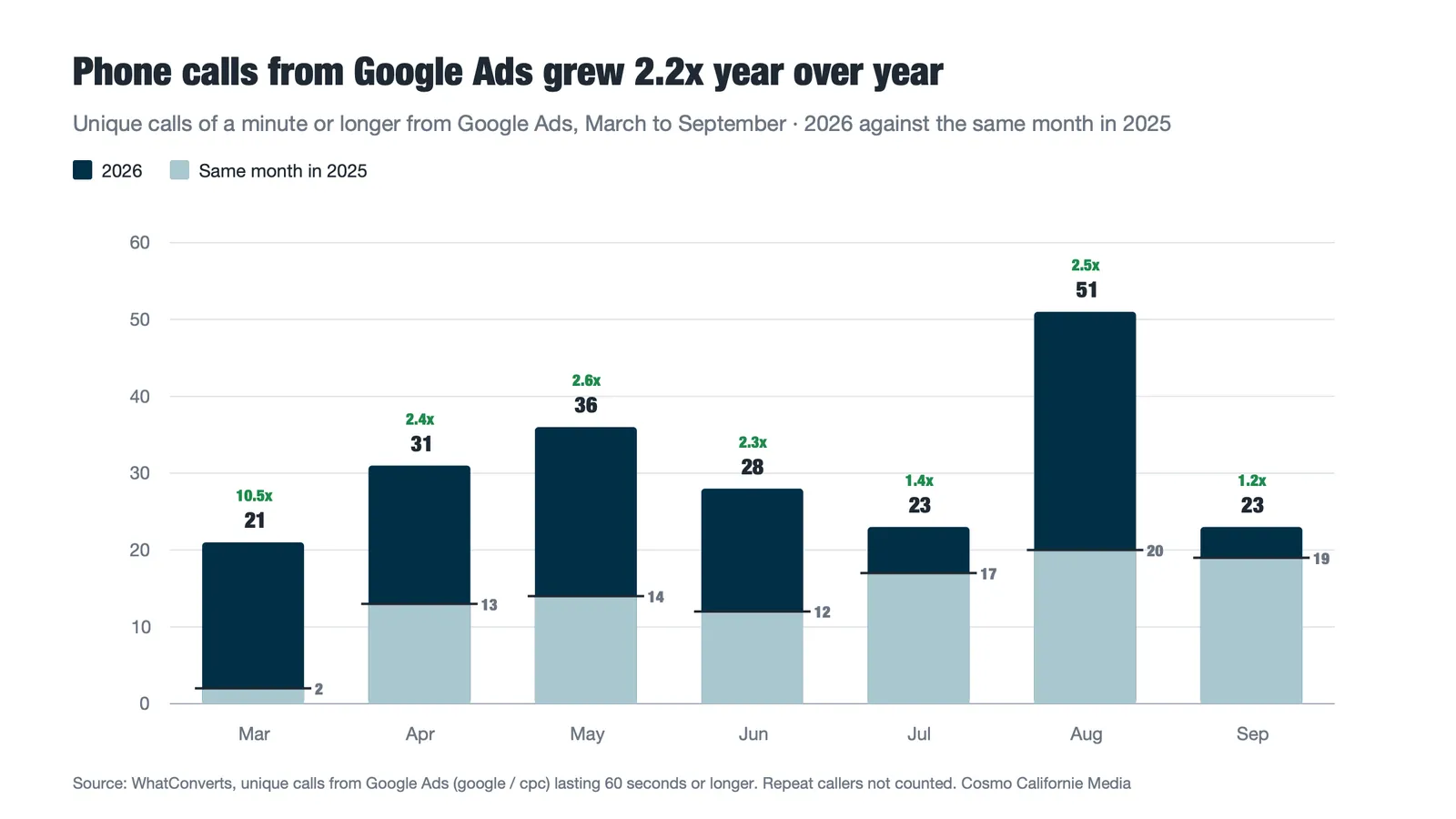
A UK motorhome dealer doubled its phone calls from Google Ads after Cosmo Californie Media took over the account in December 2025. Calls of a minute or longer went from 97 to 213 (March to September, 2025 versus 2026), leads rose 58% from 233 to 368, and cost per lead fell 22% from £24.50 to £19.15, on a budget of about £1,000 a month. We listened to every recorded call each week, split the showroom and the workshop into two business units with their own budgets, and moved the money toward motorhome buyers.
- Client
- UK motorhome dealer with a service workshop (not named)
- Industry
- Automotive retail, leisure vehicles
- Services
- Google Ads management, call listening and lead qualification
- Period
- December 2025 to September 2026, compared year over year (March to September)
- Tools
- Google Ads, WhatConverts call tracking
- Reported in
- GBP, WhatConverts unique leads from Google Ads
Challenges / Opportunities
A UK motorhome dealer sells new and used motorhomes at around £50,000 each and runs a workshop alongside the showroom for servicing, habitation checks, MOTs and parts. Buyers find the dealer online, then call or fill in a form, and the sale itself closes in person at the dealership.
The Google Ads account launched in March 2025 under another manager. It ran two search campaigns built around buying a motorhome, but the workshop ad groups for servicing, habitation checks and MOTs sat inside the local buying campaign and shared its budget. From March to September 2025, workshop searches took 24% of the ad spend at £1.24 a click, while general motorhome searches such as "6 berth motorhomes for sale" and "motorhome dealers near me" took 15% at £0.23 a click. The workshop was paying more than five times as much per click for a service worth a fraction of a motorhome sale. Over those seven months the ads brought in 233 unique leads at £24.50 each, and about a quarter of them came from workshop searches. In the autumn the budget was cut from £1,000 to £650 a month for the off-season.
A workshop booking is worth a few hundred pounds and a motorhome sale is worth about £50,000, but in the account each one counted as the same lead.
We saw two opportunities. The first was to treat the showroom and the workshop as two business units, each with its own budget and its own KPIs, and put most of the money behind motorhome buyers, where a single sale is worth more than four years of the ad budget. The second was to listen to the calls coming in from the ads every week and, based on what we learned while listening in, make immediate changes in the account.
Client Results
- 2.2x phone calls of a minute or longer: 97 (March–September 2025) → 213 (March–September 2026)
- 58% more leads from Google Ads: 233 → 368 unique leads over the same seven months
- Cost per lead down 22%: £24.50 → £19.15
- Cost per phone call of a minute or longer down 44%: £58.85 → £33.09
- 2.1x leads outside the workshop: 173 → 363, while leads from workshop searches went from 60 to 5
Leads are unique calls and forms from people who clicked a Google Ads ad, tracked in WhatConverts the same way in both years. Repeat callers aren't counted.
The Work We Did / Lessons Learned
Listening to every call. We took over the account in December 2025 and started getting our ears dirty: every week we listened to the recorded calls from the ads in WhatConverts, one by one. It's slow, manual work, and it's where we learned the most. The calls told us things that never came up in the monthly meetings with the client, and that Google Ads had no way to optimise on without someone listening in. The dealer doesn't rent out campervans, doesn't repair trailers and doesn't sell or service caravans, yet broad match keywords were bringing in searches for all three. In January we paused the campervan hire keyword and built a negative keyword list for caravan and trailer searches.
Two business units with their own KPIs. In January we split the local campaign in two, one for buying and one for the workshop, with £6 and £4 a day. From then on we judged them as separate business units, each with its own budget and its own cost per lead target, so a cheap workshop lead could no longer hide the cost of finding motorhome buyers, or the other way round.
Pausing ads the workshop couldn't take. In February we heard four callers from the ads being told the workshop was fully booked for habitation checks until May. We paused the habitation check and MOT ad groups the same week, without waiting for the next client meeting. In March the dealer's staff were telling callers the workshop was booked for servicing and repairs until June, so we paused the workshop campaign and moved its budget to the national buying campaign, which was losing 68% of its possible impressions to budget. The client had a budget limit of £1,000 a month, and by June, when the workshop had room again, it didn't make sense to turn its ads back on. The account was getting a much stronger return fully focused on motorhome buyers, so from June the workshop searches took none of the spend.
Budget behind motorhome buyers. At the end of February the client approved a return to £1,000 a month, and the extra budget went to the general motorhome searches. "6 berth motorhomes for sale" and "motorhome dealers near me" became the account's two biggest keywords, and general motorhome searches cost £0.23 a click on average, against £1.24 for the workshop searches the year before. "Motorhome dealers near me" went from £11 of spend in December to between £175 and £261 a month from February. This is the same approach we took with a UK ducting supplier, putting budget behind the products where the business has a real edge. For this dealer that's the motorhome sale.
Quotable leads checked by hand. From February we marked each lead in WhatConverts as quotable or not: purchase and part-exchange enquiries, plus any parts or repair request that needs a price. In a typical week of 6 to 16 leads, two to four were looking to buy a motorhome, and the rest were parts, servicing, buybacks and existing customers. Reviewing them every week told us which searches brought buyers, and fed the search term clean-up and the cost per lead targets we set for each campaign.
The main lesson is that a lead count treats a £150 habitation check and a £50,000 motorhome the same way. Listening to the calls showed us which leads the dealer could sell to and which ones the workshop had no room for. Moving the budget toward buyers brought in twice the calls at a lower cost per lead. The client didn't have to brief us on any of it. They ran the dealership, and each week the ads followed what their team was telling callers on the phone.
Results & Lasting Benefits
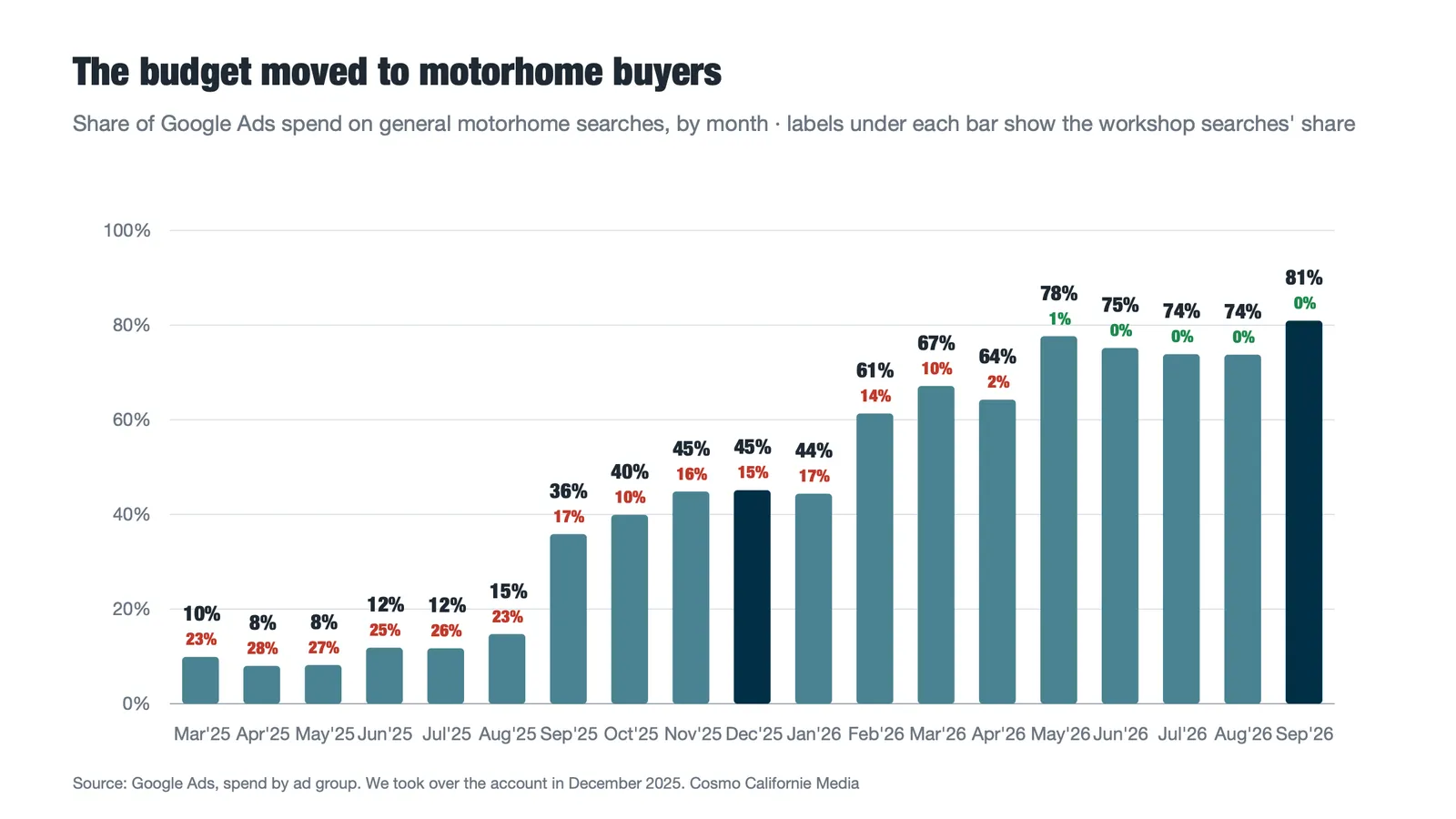
Ad spend went from £5,708.29 between March and September 2025 to £7,048.19 over the same months of 2026, with March 2025 the account's first, partial month. General motorhome searches went from 15% to 73% of the spend and workshop searches from 24% to 2%. Clicks doubled, from 14,442 to 28,795, and the cost per click fell from £0.40 to £0.24:
| Month | Ad spend 2025 → 2026 | Leads 2025 → 2026 | Calls over a minute 2025 → 2026 | Cost per lead 2025 → 2026 |
|---|---|---|---|---|
| March | £258 → £1,022 | 7 → 50 | 2 → 21 | £36.79 → £20.45 |
| April | £912 → £1,004 | 27 → 51 | 13 → 31 | £33.79 → £19.68 |
| May | £911 → £1,004 | 31 → 52 | 14 → 36 | £29.39 → £19.32 |
| June | £907 → £1,004 | 34 → 55 | 12 → 28 | £26.68 → £18.26 |
| July | £902 → £1,004 | 40 → 43 | 17 → 23 | £22.55 → £23.35 |
| August | £913 → £1,005 | 50 → 78 | 20 → 51 | £18.25 → £12.88 |
| September | £906 → £1,004 | 44 → 39 | 19 → 23 | £20.58 → £25.75 |
Leads are unique calls and forms from Google Ads, tracked in WhatConverts. August 2025 was the best month the account had before we took over, and August 2026 beat it by 56% at a lower cost per lead.
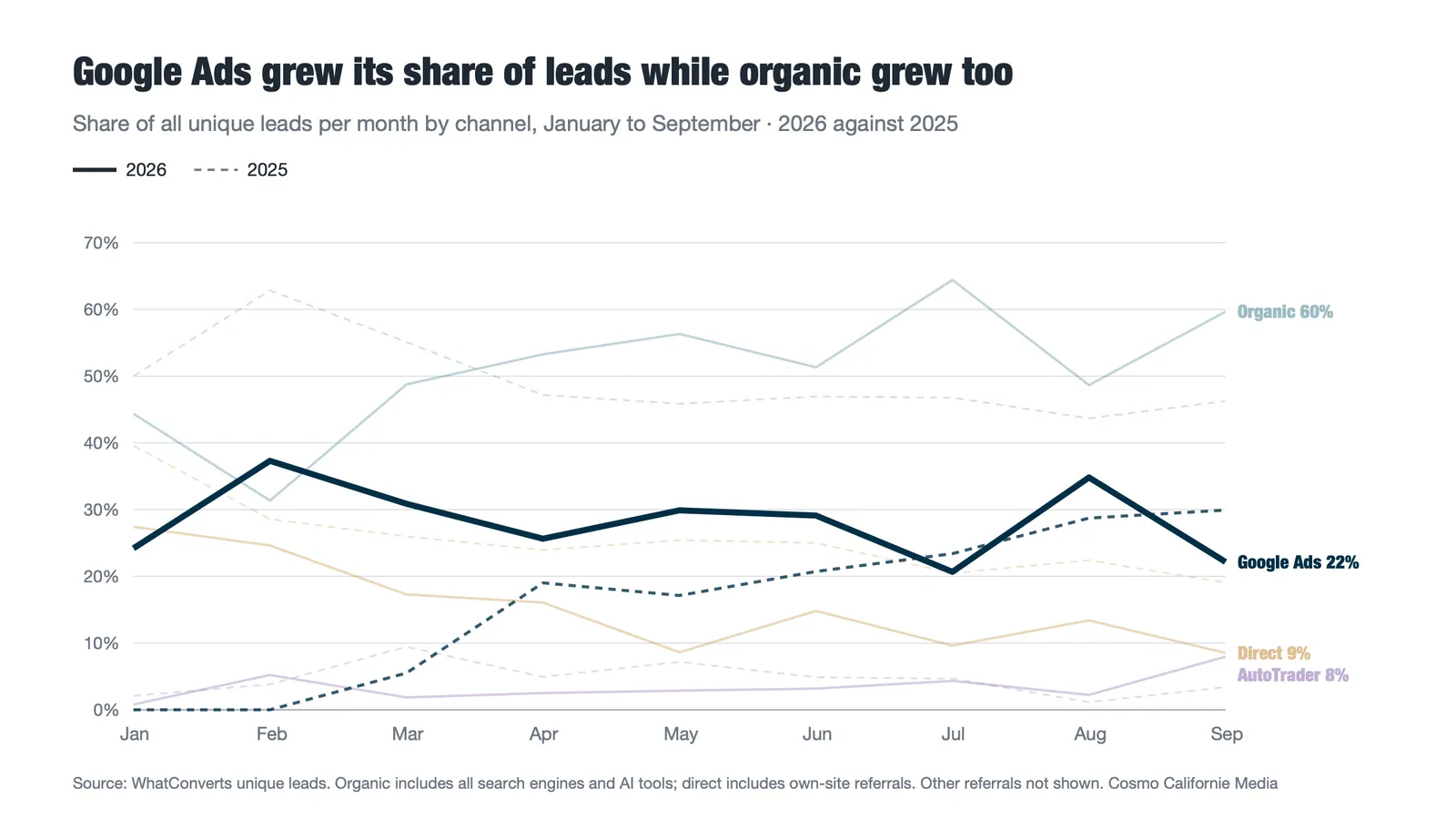
Organic leads grew 40% over the same months, from 521 to 728, and Google Ads still grew its share of all the dealer's leads on a similar monthly ad spend, from 21% between March and September 2025 to 28% in 2026. The biggest jump came in February 2026, the month after we split the buying and workshop budgets and cleaned up the search terms, when Google Ads went from 24% of all leads in January to 37%.
From February, when we started marking quotable leads, to the end of September, the account brought in 181 of them. In the first four months, February to May, 72 quotable leads cost £53.03 each. In the last four, June to September, 109 cost £36.86 each, 30% less. About 40% of quotable leads are enquiries to buy a motorhome.
If your ads bring in leads your business can't take, or treat a small job the same as your biggest sale, shoot me a message and we can map out where your budget should go.
Book a CallQuestions about this case study
What does "getting our ears dirty" mean in this case study?
Every week we listened to the recorded calls that came in from the ads in WhatConverts, one by one. The calls showed us things the monthly client meetings never covered, such as searches for campervan hire, caravans and trailers the dealer does not serve, and workshop callers being told the workshop was fully booked. We changed the account the same week each time, with negative keywords, paused ad groups and budget moves.
Why were the workshop ads paused?
In February 2026 we heard callers being told the workshop was fully booked for habitation checks until May, and in March the staff were telling callers it was booked for servicing and repairs until June. We paused those ad groups, then the workshop campaign, and moved its budget to the national buying campaign, which had been losing 68% of its possible impressions to budget. A workshop booking is worth a few hundred pounds and a motorhome sale about £50,000, so the budget stayed with buyers.
How were leads counted, and did the definition change?
Leads are unique calls and forms from people who clicked a Google Ads ad, tracked in WhatConverts the same way in both years, with repeat callers excluded. Google Ads' own conversion counts changed when tracking was rebuilt, so they are not used for the comparison. From February 2026 we also marked each lead as quotable or not by hand.
What happened to cost per lead and cost per click?
Cost per lead fell from £24.50 to £19.15, and cost per phone call of a minute or longer fell 44%, from £58.85 to £33.09. Clicks doubled from 14,442 to 28,795 while the cost per click fell from £0.40 to £0.24, because general motorhome searches cost £0.23 a click against £1.24 for workshop searches. Quotable leads cost £53.03 each from February to May and £36.86 from June to September, 30% less.
Did organic leads fall when paid leads grew?
No. Organic leads grew 40% over the same months, from 521 to 728, and Google Ads still raised its share of all the dealer's leads from 21% to 28% on a similar monthly ad spend. The biggest jump came in February 2026, the month after the buying and workshop budgets were split, when Google Ads went from 24% of all leads to 37%.
Working with us.
Let's figure out where your growth is getting stuck.
Book a discovery call with Sonny — a focused conversation about your business and where the opportunities are.
Book a Discovery CallMore case studies

B2B E-commerce Google Ads + Offline Sales Attribution
WooCommerce sales grew from £16,587 in January to £104,851 in September 2026 for a UK ducting supplier, with 93% of orders attributed to their source.

Medical Agency SEM White Label
Red-flagged accounts fell from 22 to 3 while the medical agency's book grew from 71 to 98 Google Ads accounts.
Google Ads Optimization
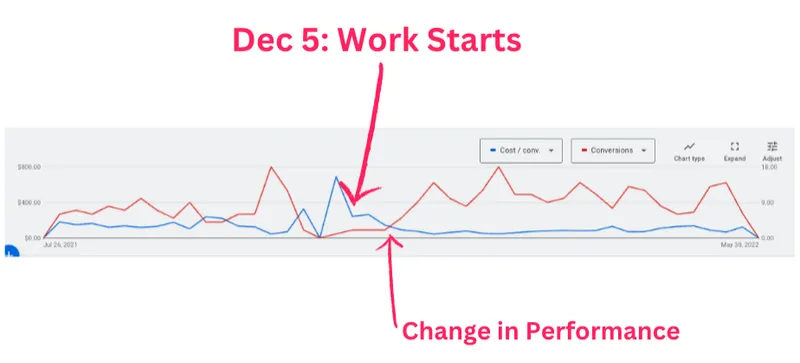
5.13x ROAS and 42.8% lower cost per lead for a medical practice with five offices across Dallas–Fort Worth.